


ATCA BLOG

This page is for ATCAns to blog about ATCA, ATCA events, other ATCAns and issues of importance to theater critics.

8:22PM

ATCA in Ashland

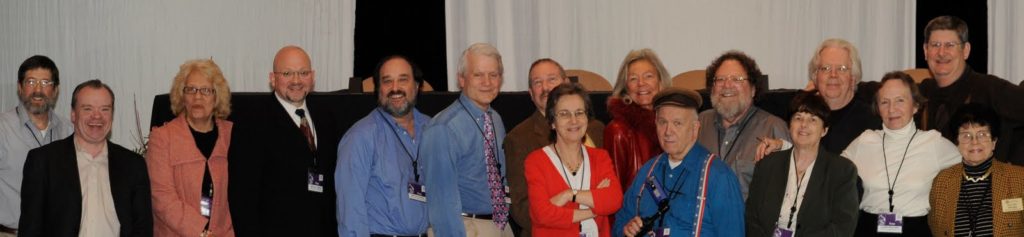
July, 6-10 — This week ATCA is in Ashland at the Oregon Shakespeare Festival for its annual conference. In so far as we can, in between meetings, panels, 8 plays, late night discussions in the Crystal Room of the Ashland Springs Hotel and the attractions of Ashland, members will post comments here on aspects of the experience.

(At right: The Bard and the Daumier critic draw their quills to duel.)

8:10AM

Jim O'Quinn, the show must go on

Neither raging fever, pounding headache nor general malaise could keep Jim O’Quinn from delivering his impeccably artistic Perspectives in Criticism speech to ATCA members and their guests, gathered last week in Ashland, OR, for their annual conference at the Oregon Shakespeare Festival.

Jim, a New Orleans Times-Picayune city desk reporter in his salad days, shared salad day stories, poked fun at himself with archival clips and photos and laid out some answers to the question, “What are Critics For?”

Making connections, was the simple answer: of course between the stage and the audience, but in a broader sense, between art and society.

Regarding that connection factor, Jim reveals that American Theatre mag is going live online later this year.

BTW, after his presentation, Misha Berson whisked him off to a walk-in clinic in Medford. Sante, Jim, and thanks for making the show go on.  — Lynn Rosen


(NOTE that the seagull above Jim’s head is left over from last year’s O’Neill conference.)

8:20PM

Round the clock in Ashland

Although it’s pretty mellow in beautiful Ashland, the home to the Oregon Shakespeare Festival, this small mountain town has been the site for an energized ATCA conference.

With the OSF’s provocatively contemporary productions of not only Shakespeare, but also Moliere and(Rear) Paul Hyde, Barbara Bannon, Judith Reynolds and (front) Ashley Polasek around a post-show roundtable Gilbert & Sullivan, ATCA members are having great fun rolling up their critics’ sleeves and having at it during post-show round-table discussions. This new conference offering takes us frequently into the wee hours. Despite the consequential lack of sleep, I for one hope these round table discussions will become a regular feature.

Two shows I have particularly enjoyed were “Julius Caesar” with a female Caesar … and “August: Osage County,” which had to be moved into a tent when the original venue suffered a massive crack in a support beam. Along with other colleagues, I’m most impressed with how the designers, cast and crew worked the sudden move with such elan.

Looking forward to Chicago in 2012! But after these warm days and cool nights — not to mention Oregon wines, beers and wild salmon — we’re a little spoiled. — Pam Harbaugh

11:30AM

The Bowmer Beam, or, Bowmer in the Park


Jay Handelman, Lynn Rosen and Bruce BurgunJust experienced the remarkable first-ever opening of the Bowmer in the Park tent production of “August: Osage County” — yes, in a tent in Lithia Park adjacent to the Oregon Shakespeare Festival in Ashland, OR. Why is Bowmer in the Park? On June 15, a 78’x14”x70’ supporting beam of the Bowmer Theatre cracked during a rehearsal and the building was declared unsafe. Scramble, regroup, rinse, repeat et voila! After only one performance (that night) was canceled, plans B,C and D went into actiion. The OSF cares about its audience and the experience today at the first-ever BITP was spectacular. Don’t miss an opportunity to visit this amazing venue. — Lynn Rosen

Click here for more of Lynn’s posts on Ashland and OSF.

11:15AM

On the way to Ashland

Somewhere on the way westward from Pittsburgh on the multi-leg flight necessary to keep the price down, I saw a placard declaring this National Ice Cream Month. Actually, it’s always National Ice Cream Month for me. But on first encounter with Ashland, it seemed providential: you can tell immediately that this is one of those perfect, silky-tasting towns just about as good as ice cream.You have to love a place that knows how to treat its dogs

My favorite leg was the last. Getting off the plane in Medford, as I walked past the cluster of fellow travelers waiting for checked luggage, I announced, “Anyone going to Ashland? Ashland? Anyone”

“Hey, Mon, you going to the Shakespeare Festival?” was the reply. And that’s how I got a ride for that final half-hour from Mongezi and Kuku, two South African musicians from Washington, DC on their way to play this week in the festival’s Green Show.

Not that I’ve seen the Green Show yet, the pace of shows and panels and time with ATCA friends has been so intense. But the ice cream hasn’t disappointed me — the best place in town is just across from the hotel. – Chris Rawson

1:36AM

ATCA on Broadway (and thereabouts)

About 50 ATCA members gathered in NYC, Feb. 4-6, for a weekend conference (aka “mini-meeting”). In between panels and shows and the hurlyburly of The City, a few took a short break to file a comment, and more are expected. 

9:40AM

Who could ask for anything more?


Before spending time with my new ATCA colleagues in New York, I was under the impression that most performers/writers/directors shy from reviews, so I was pleasantly surprised with those who confessed to reading them and how many said that both the good and bad live on in their minds and hearts. I tend to think of theater criticism as a service to the reader who is the potential audience, not as the critic telling the creative team how to do its job.

A few folks seemed to think that critics who point out flaws or question an artist’s vision are unkind or destructive. I thought the point was to convey to our readers our opinions of a work based on experience and expertise. I heard more than one person on the playwrights/producers panel say, “we are in this together,” apparently meaning their work needs critics’ support to survive and that newspapers are fighting for survival, too. The inference seemed to be that critics are bound to be kinder and gentler and not express a strong opinion. That was the only disconnect I felt through the whole glorious weekend. We have in common that we both serve audiences, and I did agree that honesty and generosity serve us both.

As someone who has returned to theater criticism after a long hiatus, the conference was inspiring — who wouldn’t be inspired hearing Andre De Shields’ appreciation for a critic’s recognition of what he brought to “Death of a Salesman”? The discussions of mentoring and the need to add diversity to the ranks of critics reminded me of discussions at the NEA’s fellowship for mid-career theater critics almost a decade ago, so I hope we take that to heart and get past the discussion stage.

To the point: I learned a lot; I met fascinating, talented people; I found many topics worthy of further discussion; and I had the opportunity to see Spider-Man, Al Pacino, Michael Shannon and Brian Bedford onstage. Who could ask for anything more?  — Sharon Eberson, Pittsburgh Post-Gazette


2:00AM

Great moments and push-back in NYC

Some great moments in ATCA’s mini-meeting in NYC:

* At the Sardi’s brunch, celeb guest Dan Lauria sounds like Vince Lombardi: “I like the challenge. I’m a Marine. Come on. Bring it on.” His stage wife in Lombardi, Judith Light, looks ethereal as she allows the winds of the universe to flow through her career. Solid talent Stacy Keach is handsome as he responds to his introduction. Dana Ivey, an actress with chops, was drawn to the theater by “language and tiaras.”  Add the estimable composure of Jeffrey Wright and the earnest grace of radiant young Lily Rabe to the glow of fabulous guests like Andre DeShields, Linda Lavin, and Paxton Whitehead, and you get some idea of the drama and the glory.

* At a discussion session, Mirror Rep co-founder Sabra Jones explains The Method at last: “It’s not all these pieces you plug in, but a pill you take.”

* Playwright Richard Nelson notes that the best critics will hold playwrights and theaters to the artists’ highest standards. And he observes that fine critics articulate back to the playwright even as they inform their readers.

* Three critics with a geek side —Andy Propst, Leonard Jacobs, and Andrew McGibbon—tie up ATCA’s mini-meeting with humor and gently packaged tech info for the clueless and cognoscenti alike.

Some push-back on the Perspectives on Criticism panel:

Adam Rapp, a playwright whose work I respect, set us straight about theater criticism. The critic, he assured us, is not going to offer any new perspectives, as the bright people involved in the process of producing a play are perfectly capable of figuring out its problems. (Refresh my memory: How many smart people have produced how many failed plays?)

We were also assured by a successful artistic director —who doesn’t read reviews as a general rule— that the critic is just another voice. Theaters, the director explained, already have their feedback mechanisms and their blogs, where they can go if they want opinions on their shows.

Well sure, all kinds of opinions fly around in the ether. While some online chatter is superb and surely worthwhile, and professional news organizations and journals are also on the web, a large percentage of what’s out there is noise passed off as theater criticism. The more I sample reactions to any given play on theaters’ own websites and blogs, the more fundamentally necessary the serious, knowledgeable critic/ arts journalist appears to be.

All in all, that was a great mini-meeting. Congrats to the chairs. — Kathryn Osenlund, CurtainUp.com


9:11AM

A terrific New York Conference weekend

After a day of stimulating panel discussions on the theater experience from the points of view of actors, acting teachers, producers and reviewers, we were treated to the traditional Brunch with the Stars at Sardi’s. What fun it was to sit next to Jeffrey Wright while listening to comments from some greats. Had a nice chat with Judith Light.

Off soon to listen to colleagues speak about reviewing in the cyber age. I already do a lot of blogging, some tweeting, et al. But hopefully I can get some more info on using Facebook and other social media. This is ending all too soon. — Pam Harbaugh, South Florida


8:52AM

Bill Blog (Hirschman, that is)

Ah, to be in New York City when the sleet’s in bloom! Okay, it’s not April in Paris. Nor Fort Lauderdale in February (one of the most beautiful times of the year back home). But it’s not like we’re standing on an El platform in The Loop with nothing between us and the Arctic Circle but a couple of barbed wire fences. But where else can you see The Addams Family, Mamma Mia and Spiderman: Will The Last Person Leaving Please Turn Off The Dark?

It’s truly wonderful seeing folks again, a little grayer, a little balder (that’s me, I’m referring to). Again, I get to celebrate my birthday week with these folks. Saw Angels In America Part I at Signature Wednesday and Gruesome Playground Incidents Thursday. Earnest tonight.

We miss y’all who couldn’t make it, especially Ron Levitt who donated his tickets, and hope to see you in Ashland even if you have to hire a wagon train to get there. — Bill Hirschman, South Florida

1:12AM

ATCA at the O'Neill

We went to Goodspeed, too: here’s a gaggle of critics, out front, about to see “Carnival!”Brooks Atkinson said the American theater started with Eugene O’Neill — but the mayor of New London asked what did he ever do for New London except write a couple of books.

ATCA spent July 13-18 finding out what at this years’ annual conference.

Following are some quick responses to our experience. More may still arrive.

1:11AM

Drama Queen debates membership criteria

Springboarding off the ATCA/O’Neill panel on New Media for Critics in the Brave New World (or whatever we called it), Wendy Rosenfield  picked up the debate about criteria for ATCA membership. Take a look.

1:07AM

Engaging with ATCA

It’s hard to decide just which aspect of the ATCA conference was the highlight.  Certainly being at the O’Neill Theatre Center was a revelation, with the energy and constantly changing vibes of new plays, actors and playwrights.

The panels were stimulating and informative. I was especially impressed with the Critics in the New Age, where mainly our own members, among them Jay Handelman, moderator, Wendy Rosenfield and Leonard Jacobs talked about their right to an unpopular opinion, among other gems. Another feature that worked for me was hearing insights that would come at the most unlikely moments.  We were discussing a play-in-progress over breakfast that we had all seen the night before, when Lynn Rosen commented, “There was nothing at stake.”  

It was all engaging, with spontaneous times to talk to other writers at the beach, or on the bus, or after hours at Blue Genes Pub. Michael Phillips in his Perspective on Criticism talk warned against “generalities and bullshit.” That brought me up short and hopefully I’ll bring more depth and perception to this whole process.

Liz Keill, NJN Publishing/Independent Press

10:59PM

Rich rewards of the O'Neill

The rewards of this year’s ATCA convention based around the activities at the O’Neill Center are almost too numerous to name. Aside from the trying accommodations at the Radisson Hotel in New London, I and my wife LucyAnn, who teaches in the theater department at Drew University, had a fine time re-connecting and chatting with ATCA members from all over our country who share our passion and our dedication to the theater arts.

What we feel most grateful for is the opportunity each year to be a guest at a different hub of theatrical activity, most of which we wouldn’t ordinarily have the opportunity to visit. As my work as president of the Outer Critics Circle and as a critic who attends more than 200 plays a year keeps me virtually glued to the stages in New York and New Jersey, I am particularly grateful for the opportunity to get out of town and to see the often extraordinary work being developed and presented at the various regional theaters.

As for my experience at the O’Neill, I have some qualms about the direction it seems to have taken to be more accessible to producers and promoters. This could be seen in the musical and two plays that we attended, all three of which were notable for their discernable commercial potential. It’s hard for me to imagine that out of 800 or so admissions read and selected that what we saw represented the kind of creative, challenging, innovative, and possibly untraditionally structured dramatic literature that one would like to think might comprise the bulk of the product put into the development process. This approach seems to be the antithesis of the founders’ intentions.

As I respect the request not to review the readings we saw, I will only say that all three had the benefit of being performed by first-rate actors who, almost miraculously, created characters who lived and breathed in the most difficult of conditions. P.S. We both cherish the side trip to the Goodspeed Opera and the tour of its awesome facilities, as well as seeing the charming musical Carnival. I am especially thankful that we discovered Captain Scott’s Lobster Dock. But I am mostly thankful to Chris Rawson who went to extraordinary lengths to make every day of the conference eventful, informative and enjoyable.

— Simon Saltzman

4:47PM

It ain't over

The laundry is done; now the notebook gets unpacked.

I filled the better part of a good-sized Moleskine over five days at the ATCA conference—notes I intend to turn into a widely read, much-talked-about feature this fall in Dramatics magazine, where I’m fortunate enough to have a full-time job. Working title: “The Crisis in Criticism,” but I’ll confess, my first night in Waterford I wondered if I hadn’t better come up with a more ominous slug. After a fine reading at the O’Neill—“The Dream of the Burning Boy,” by David West Read, about a high school English teacher and a gifted student—I boarded the bus back to the New London Radisson with about twenty of my colleagues from across the country. Virtually all of these good people were, I noticed, well over 60 years old.

If I needed more evidence that I was hanging onto a dying profession by my fingernails, this was it.

As the conference went on, my own generation—arts journalists who still have most of our careers ahead of us, Google willing—seemed better represented. (I learned that some youngsters had stayed late at Blue Gene’s Pub that first night, whereas I’d ridden back with the early-to-bed crowd.) And while we spent a lot of time bemoaning the negative aspects of print’s decline (shorter stories, fractured readership, shaky professional standards, drastically fewer jobs paying livable wages), we also talked about ways in which the Web might actually make our work better. More vital. More relevant. More fun.

And the more time I spent with my senior colleagues—people like ATCA chair Chris Rawson, who really knows how to throw a conference (down to providing beach towels, nice!), and Simon Saltzman, president of the Outer Critics Circle and a New Jersey-based writer with curtainup.com—the more I stepped back, seeing my own career in a wider, more promising, even inspiring frame. Sure, things are different. But we’re all still doing the same work, really, and for the same reasons.

“Every year at this conference I find myself having a conversation about what we are passionate about… that makes me feel a part of a community,” Saltzman told us, during our last gathering at the hotel Sunday morning. “This remembering of the experience of being a critic with other critics who share what I love is so important to me. This is what brings me back.”

 “I always return from an ATCA conference,” Rawson added, “determined to become a better critic.”

Me too. Especially now.

Julie York Coppens, Cincinnati, OH

2:29AM

Musings on O'Neill

Friday morning we visited the Monte Cristo cottage where O’Neill spent his boyhood summers. Since my principal frame of reference is Long Day’s Journey into Night, I was pleasantly surprised by the house. I expected it to be dark and claustrophobic, but the rooms on the first floor are airy and full of light. Even the enclosed sun porch known ominously as the “long day’s journey room” is comfortable and lined by windows that look out toward the water, not at all the dreary room I had anticipated. I think I would have enjoyed spending my summers there. I admit that the bedrooms on the second floor are small, confined, and uninspiring, but O’Neill’s bedroom is at the front and also has a lovely view of sky and water. I guess the reasons that he hated New London so much were much more psychological than physical; the family was not accepted by the town or the WASP society that dominated it, and the feeling of being an outsider probably eclipsed the joy of living there.

Saturday afternoon we had some free time, and I wandered down the expansive lawn of the Hammond estate that houses the O’Neill Theater Center to relax on the beach and wade in Long Island Sound. The setting of the center is beautiful and amazingly peaceful considering the bustling activity going on all summer. As I was walking back up the hill to the mansion, I wondered what O’Neill would have been like if he had spent summers there instead of at Monte Cristo cottage. Would his outlook have been less dark and pessimistic? Or would that dark strain of Celtic fatalism have emerged no matter what his surrounding? Did he need the twin scourges of discrimination and unhappiness to shape his greatness as a writer? Did his feeling of not being acceptable help him penetrate to the core and portray other outsiders as lost and lonely, too? I wonder.

Barbara Bannon, Salt Lake City

12:19AM

A hymn to Goodspeed

I review mostly dramas.  As some of my ATCA colleagues know, I’ve Jay Handelman (left), Wendy Rosenfield, Goodspeed’s Dan McMahon and Barbara Gross encounter Domina’s bust from “Forum.”never been a big fan of musicals. I know my limitations and that’s one. Les Miserables made me miserable and Annie Get Your Gun made me want to go out and buy one … and then visit the set of Les Miserables with it.

So I am happy to report that, not only did I survive the two musicals on the schedule at last week’s ATCA conference, I actually enjoyed them — particularly the dazzling Carnival at the Goodspeed Opera House, which moved me in a way that few musicals have.   

On our all-access tour, I appreciated the tremendous amount of work that goes into a production of this scope. I was awed by the the sheer, innovative genius of Lou and his More wonders in the Goodspeed scene shop. Note the prophetic sign, addressed as much to critics as techies.colleagues at the Goodspeed’s scene shop. The largest of its kind, the shop can seemingly surmount any obstacle posed by the theater’s relatively small stage. The art of rolling backdrops onto specially built metal canisters and then unraveling them back of stage is only one of the shop’s more clever tricks.  

I was also delighted to know that the Goodspeed, always on the lookout for set and period props, might just accept your quality junk. Don’t throw away those ham radios, claw bathtubs and TV consoles! What could be more gratifying than to see your Rheingold Beer bar light cast its smoky glow over the festivities of a future production? Lou tells me you can contact him and let him know what you’ve got. If they like what they hear, they’ll come pick it up!

Bill Coyle, Flushing, NY

10:06AM

ATCA/O'Neill echoes still to come

Monday morning — The heavens opened today, as if in copious regret that the critics had left New London. Or gratitude, perhaps. It rained as we arrived on Tuesday and Wednesday, then gradually cleared to the glories of the last few days, so it all feels satisfyingly cyclical.

The official conference ended yesterday noon, though a few of us stayed for the Russian project (see below) and the traditional O’Neill barbecue. Then the over-stuffed (I mean gustatorily speaking) conference chair (that’s me) rolled gratefully into his bed to sleep 12 hours, catching up on what he’d missed during the pell-mell conference itself. To give the New London Radisson its due, they were very helpful as I settled up ATCA’s bills. Now it’s time to head home, but I expect others will send in posts for this blog in the days ahead, so check back.

Chris Rawson, Pittsburgh

10:04AM

Conference add-on: Russian play, great acting

Sunday — We’ve had some moving moments this week at the O’Neill. Must be the spectre of ATCA’s birthing Under the Copper Beech so many years ago. Sunday afternoon a few of us attended the reading of Natashina Mechta, i.e. Natasha’s Dream at the Rose Barn Theater. Billed as “The Russian Project,” it was a special (may I add, a VERY) special matinee performance of a new play by young woman Russian playwright Yaroslava Pulinovich.  A one woman tour de force deftly delivered by actress Mattie Hawkinson who had rehearsed a mere two days. She drew chills, shudders and tears. She’s one of those “Remember her Names.” Audience members George White and Dina Merrill were looking fab.

Lynn Rosen, Bellingham, Wash.

10:00AM

Our little friend

Saturday — This was the perfect time for the ATCA crowd to visit the Eugene O’Neill Theater Center for a few days. The O’Neill had just won the Tony Award for Regional Theater, an award it certainly deserves for its years of resolute, proactive, and vigorous nurturing of theater artists.

The shiny new Tony was squired around to performances, meetings, and celebrations by suave young Exec Director, Preston Whiteway. Palpable joy cut loose in whoops and applause at each site as he unwrapped the award, which he carried hidden in a black O’Neill tee, and introduced it to the theater community with, “Say hello to my little friend.”

Kathryn Osenlund, Philadelphia (and ’07 O’Neill NCI critic fellow)